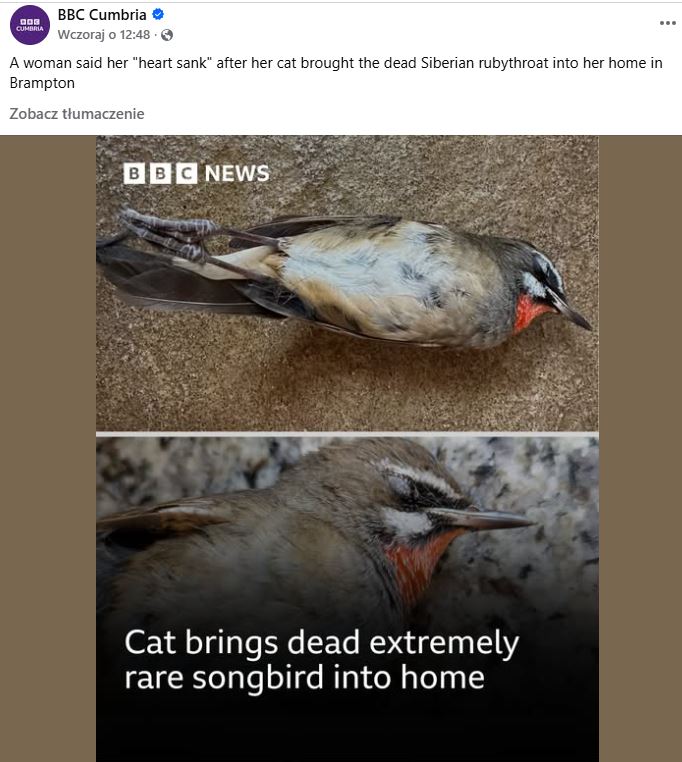

Reports of a domestic cat bringing home a dead, extremely rare Siberian rubythroat in the UK have sparked commentary about the owner’s supposed shock. From the perspective of ethology and ecology, such surprise is entirely unwarranted. Letting a predator roam unsupervised outdoors is a conscious human decision with completely predictable consequences.
Recent UK media reports, including BBC Cumbria, about a Brampton resident whose „heart sank” after her domestic cat brought home a dead Siberian rubythroat (Calliope calliope) are a textbook example of cognitive denial. From the standpoint of ethology and behavioral biology, there is nothing surprising about this outcome. The domestic cat (Felis catus) is a specialized, opportunistic predator whose hunting sequence operates independently of hunger. This animal does not select prey based on conservation status – to its nervous system, the movement of a small bird triggers the exact same predatory response, whether it is a common sparrow or an exceptionally rare vagrant from Asia.
Responsibility for the death of a protected bird does not lie with the cat, which is merely fulfilling its hardwired species-specific instincts, but exclusively with the human. Granting a domesticated, human-subsidized predator unrestricted, unsupervised access to the outdoors is a deliberate decision to introduce an invasive, non-native hunter into the local ecosystem. An owner who chooses this model of care accepts its inevitable consequences – including predation on wild birds, reptiles, and small mammals, as well as severe risks to the cat’s own health and life. Feigning shock the moment a predator brings prey indoors does not absolve the owner of accountability for failing to implement basic prevention.
The Brampton incident reflects a broader, deeply flawed approach to nature conservation that has dominated the UK for decades. In one of the most nature-depleted countries in the world, cultural sentimentality and the outdated social norm of the „free-roaming cat” are consistently placed above empirical ecological data and genuine biodiversity protection. Subsidizing millions of predators while permitting them to hunt native and migratory avifauna without restriction exposes a glaring systemic hypocrisy. True conservation cannot rely on wishful thinking or treat every dead wild animal as an unfortunate accident – the only effective and ethical solution is keeping domestic cats indoors or within properly secured outdoor enclosures (catios).